
Not therapy
It doesn’t diagnose or treat anything and gives no medical advice. It has never been in a clinical trial, so we make no claim about its effect.
For therapists and coaches
DayDare gives your client one small real-world social mission a day, the words to start with, a forecast of their fear before they go and a thirty-second log afterwards. It isn’t therapy and it doesn’t stand in for you. It’s practice your client keeps, and can bring back to the session.
How it fits
Your client opens today’s mission and, if they like, answers one question: “How much fear do you think will be left right afterwards?”, from 1 to 5. For most missions, What to say gives them an opening line, a reply for a one-word answer and a way out if it’s a no.
A Live Activity keeps the mission on the Lock Screen while they do it. Its timer counts up, not down, so there’s no deadline at the door. Most missions take two to ten minutes.
They log Did it, Partly or Not today, then their fear just before starting and right now, both from 1 to 5, and a note if they want one, typed or dictated. An honest “Not today” still counts the day, so a hard week doesn’t have to turn into hiding.
Already in the app
None of this needs an account or a server. It’s worked out on your client’s phone from their own journal, and they decide what to show you.
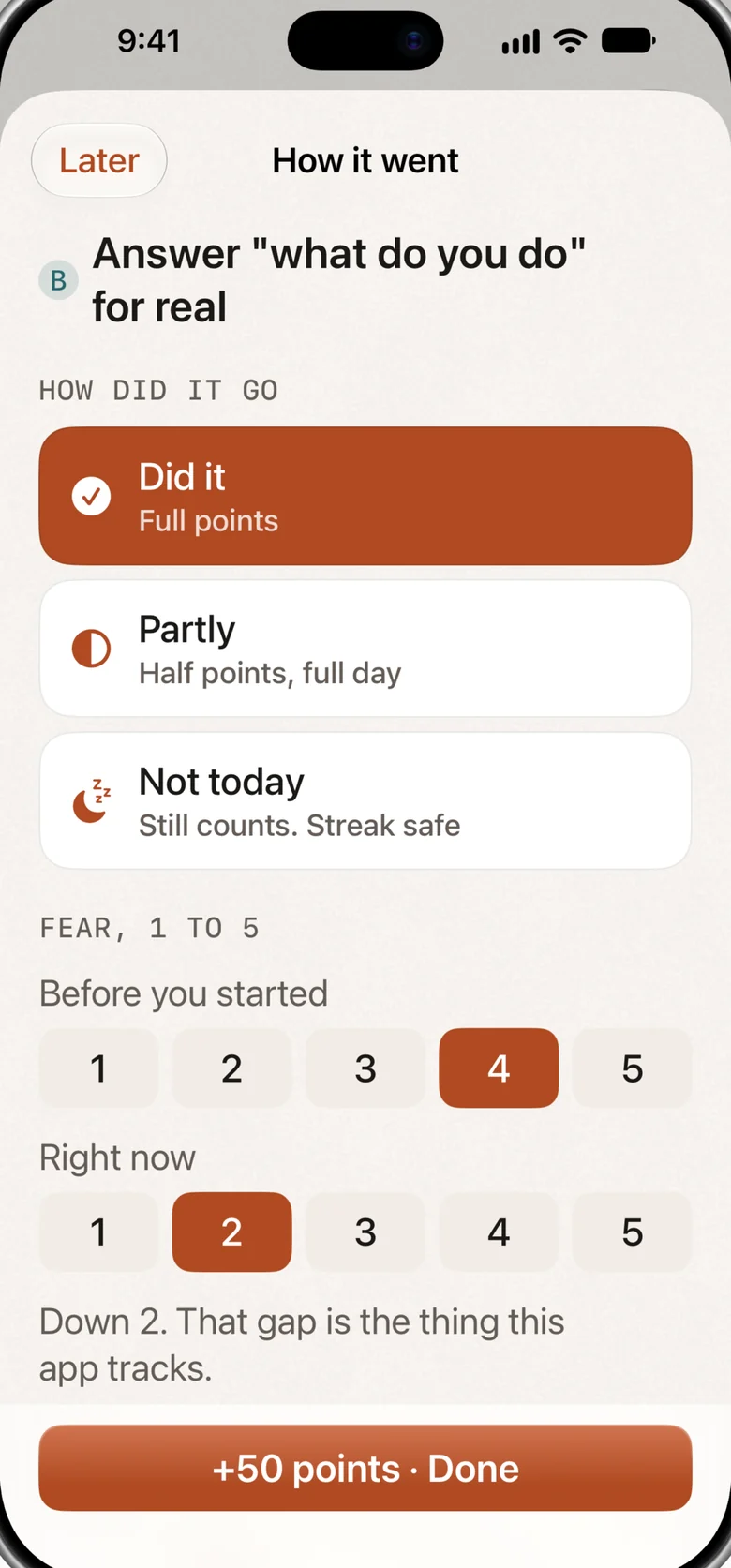
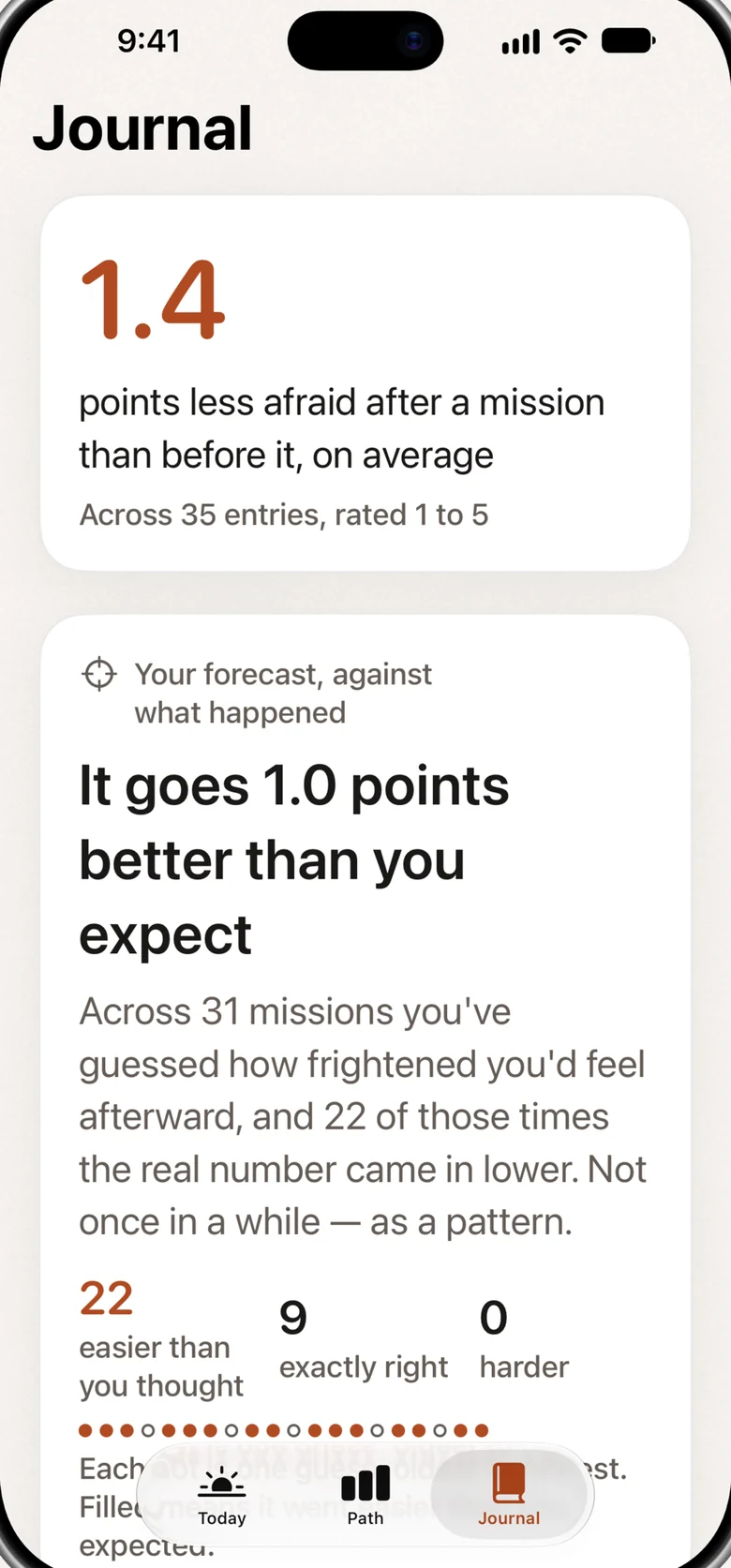
Sample · made-up data
This is what a one-page summary for a session could look like. The client and their numbers are made up, and DayDare doesn’t make this page yet: today your client can share the one-page record above or the whole journal.
Everything on it comes from what the app already records, so whether we build it depends on whether it would help you. If it would, tell us what belongs on it and what doesn’t.

Honest limits
It doesn’t diagnose or treat anything and gives no medical advice. It has never been in a clinical trial, so we make no claim about its effect.
In the study cited below, exposures guided by a therapist changed what patients expected more than the same work done alone as homework. DayDare is the homework half. The session is yours.
There are 100 missions, and you can’t add your own or assign a particular one yet. The app picks one a day from your client’s level and the places they say their life happens, and they can swap it once a day. In Path, they can read every mission’s words ahead of time.
Fear is a plain 1-to-5 rating, not SUDS or a validated scale. The forecast asks how much fear will be left afterwards, not how likely the feared outcome is.
There’s no clinician dashboard and no account, and nothing is sent to you or to us. You see what your client chooses to show you.
Missions are small and social: a café, a shop, work, a message to a friend. Every one respects a no. DayDare is rated 16+. Whether it suits a particular client is your call.
The missions
A ladder moves up after two “Did it” in a row and down after two “Not today”. “Partly” holds it where it is. The words are written for eight kinds of people, each difficult in a different way, so they fit the person in front of your client.
Being visible: your eyes, your voice, your phone in your pocket
Level 1Phone in your pocketLevel 3One second longerLevel 5Take the compliment
Starting a conversation and keeping it going two more lines
Level 1Ask the baristaLevel 3The second lineLevel 5Answer “what do you do” for real
Asking for things, and surviving a no
Level 1Ask for directionsLevel 3Borrow somethingLevel 5Ask for it at work
Moving a contact out of your phone and into your life
Level 1Send the thingLevel 3Coffee, fifteen minutesLevel 5Ask the intimidating one for coffee
Saying what’s true, and listening
Level 1Say what you likedLevel 3How are you, reallyLevel 5The conversation you’ve been avoiding
Gathering people around you
Level 1This seat’s freeLevel 3Host a walkLevel 5Say a toast
Evidence
In the inhibitory learning account of exposure, the practice that teaches most is the one where what happens differs most from what was expected (Craske and colleagues, 2014). A study of 8,484 exposure exercises by 605 patients with anxiety disorders, treated with exposure-based CBT, sharpened that. The surprise by itself didn’t predict how treatment went. A change in what patients expected, and how fast they learned, did. Exposures guided by a therapist produced more of that change than self-guided ones (Pittig and colleagues, 2023).
DayDare’s forecast is a simple, everyday cousin of that idea: one number before, one after, and how the forecast moves over weeks. It isn’t a measure of threat expectancy, and nothing here shows that DayDare changes anyone’s outcome.
More on the studies the design leans on
Privacy
No account, no email, no analytics, no ads, no AI and no DayDare server. The journal lives in your client’s own iCloud, and dictated notes are transcribed on the device. The App Store privacy label reads Data Not Collected. We can’t see which missions anyone does, or that they opened the app. We chose not to know.
If you’d like to try DayDare before suggesting it to anyone, write to us and we’ll send you a free code. And if a page like the sample would help your work, tell us what should be on it. You’ll hear back from a person.
$6.99, paid once. No subscription and no in-app purchases$2.99 until December 1, then $6.99